
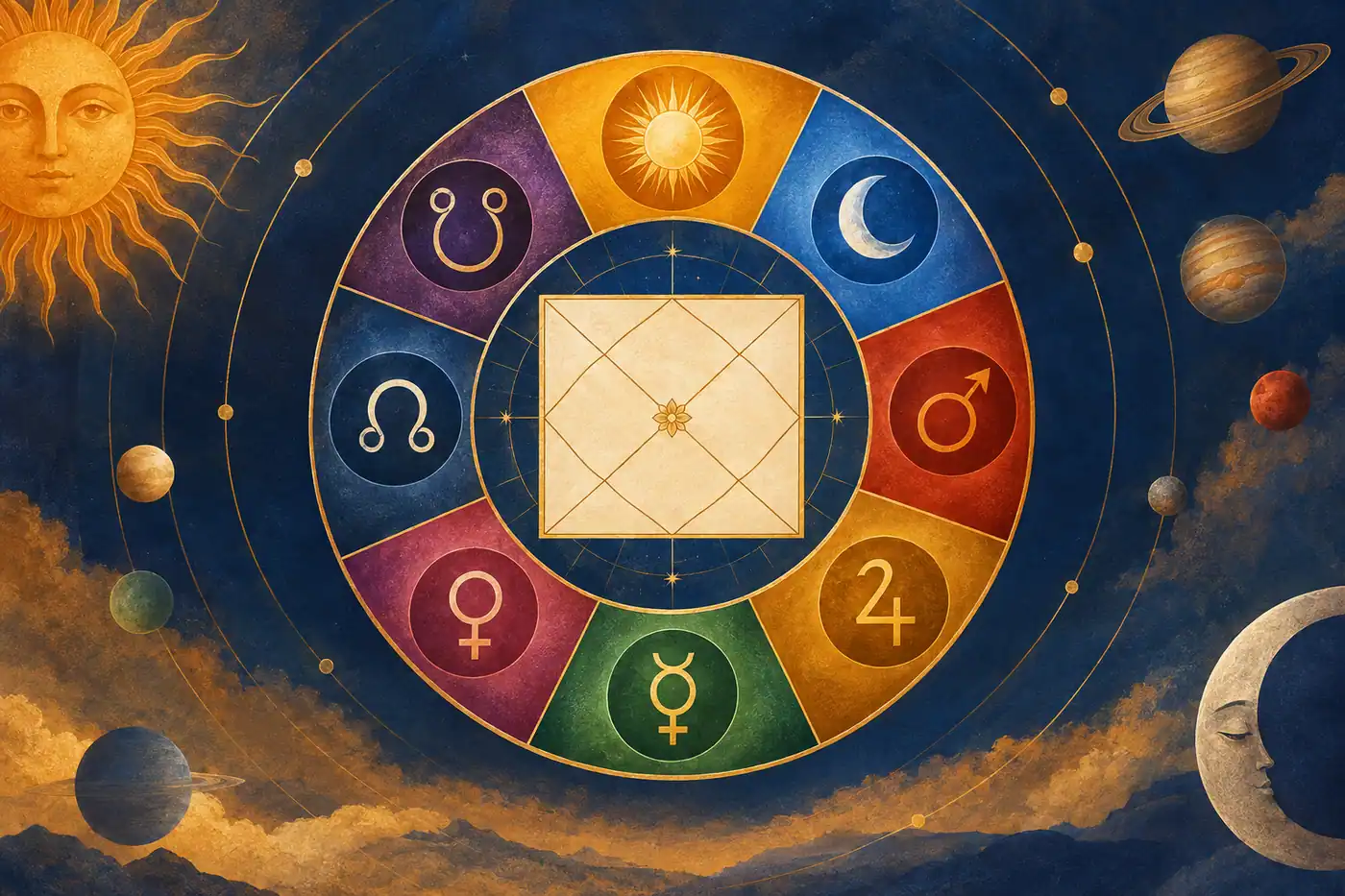
The Vedic dasha system is a timing framework used in Jyotish to organize a person’s life into planetary periods. The main period is called a mahadasha; a smaller period operating within it is an antardasha or bhukti. Together, they provide a symbolic timeline for considering which planetary themes may receive emphasis at a given time.
A dasha is not a guaranteed event schedule. It is interpreted alongside the birth chart, planetary placements, houses, aspects, transits, and the question being asked. This guide explains the basic structure so you can understand a dasha timeline without treating it as an unchangeable prediction.
What does “dasha” mean in Vedic astrology?
In Jyotish, dasha generally refers to a planetary-period system. Rather than treating every planet as equally active at every moment, the system assigns periods in which one planet becomes the principal timing indicator. Different dasha methods use different rules, but Vimshottari dasha is one of the best-known systems used for many natal-chart readings.
The word “period” does not mean that a planet acts alone. A planet’s dasha is read through its condition in the natal chart: its sign, house, dignity, relationships with other planets, and connection to relevant life areas. The same planetary period can therefore be interpreted differently for different people.
Key dasha terms at a glance
| Term | Meaning | How it is used |
|---|---|---|
| Dasha | A planetary-period framework | Organizes timing in a chart |
| Mahadasha | The major planetary period | Describes the broad background theme |
| Antardasha | A sub-period within a mahadasha | Adds a shorter-term layer of interpretation |
| Pratyantardasha | A sub-period within an antardasha | Provides finer timing when the method includes it |
| Vimshottari dasha | A commonly used dasha sequence | Assigns periods to nine grahas over a complete cycle |
| Birth nakshatra | The lunar mansion occupied by the Moon at birth | Helps determine the starting point in Vimshottari dasha |
How Vimshottari dasha is arranged
Vimshottari dasha uses nine planetary rulers: the Sun, Moon, Mars, Rahu, Jupiter, Saturn, Mercury, Ketu, and Venus. In the traditional scheme, their assigned mahadasha lengths add up to a 120-year cycle:
- Sun: 6 years
- Moon: 10 years
- Mars: 7 years
- Rahu: 18 years
- Jupiter: 16 years
- Saturn: 19 years
- Mercury: 17 years
- Ketu: 7 years
- Venus: 20 years
These are the traditional period lengths within the system, not promises about what will happen during each period. The sequence is cyclical, and the starting point is calculated from the Moon’s nakshatra at birth. The exact beginning and remaining portion of the first period depend on the Moon’s position within that nakshatra.
What are mahadasha and antardasha?
The mahadasha provides the larger timing context. If someone is in a Jupiter mahadasha, for example, an astrologer may examine Jupiter’s role in the natal chart and the subjects associated with the houses it influences.
The antardasha introduces a second planetary influence inside that major period. It is not simply a separate prediction. The mahadasha and antardasha are read together, including their relationship in the natal chart. A favorable or challenging interpretation depends on the complete chart rather than the planet’s name alone.
Some readings add still smaller layers, such as pratyantardasha. Finer subdivisions can make a timeline more detailed, but detail does not automatically make an interpretation more certain. A useful reading should explain why a period is being emphasized and what evidence in the chart supports the interpretation.
How is a dasha timeline calculated?
A basic Vimshottari dasha calculation follows this outline:
- Establish the birth data. The calculation requires an accurate birth date, birth time, and birthplace or location setting.
- Locate the Moon. The Moon’s sidereal position is used to identify its birth nakshatra.
- Identify the nakshatra ruler. Each nakshatra is associated with one of the nine Vimshottari rulers.
- Calculate the balance of the opening period. The Moon’s position within the nakshatra affects how much of the first mahadasha remains at birth.
- Lay out the sequence. The remaining mahadashas follow the established order and their traditional durations.
- Calculate sub-periods. Antardashas are derived within the mahadasha, with their lengths proportional to the planetary period scheme.
Small differences in recorded birth time or in the calculation settings can affect the displayed starting balance and the dates shown on a timeline. That is why a dasha result should be checked against the birth information used to generate it.
How to interpret your current dasha responsibly
Use this checklist when reading a dasha timeline:
- Confirm the system. Check whether the reading uses Vimshottari dasha or another method, and note the ayanamsha or chart settings if provided.
- Verify the birth details. A dasha timeline is only as meaningful as the birth information behind it.
- Study the mahadasha planet in context. Look at its sign, house, dignity, conjunctions, aspects, and house lordship in the chart.
- Add the antardasha planet. Consider how the sub-period planet relates to the mahadasha planet and to the houses relevant to your question.
- Compare with transits. Dasha is one timing layer; transits and the natal promise are commonly considered alongside it.
- Translate symbolism into practical choices. Use the reading to identify habits, priorities, or questions, not to surrender responsibility for decisions.
- Watch for overconfident claims. Exact promises about illness, death, guaranteed wealth, or unavoidable relationship outcomes are not responsible substitutes for careful interpretation.
What can a dasha reading help you explore?
A dasha reading can provide a structured way to reflect on themes such as work, education, relationships, finances, family responsibilities, spiritual practice, and personal discipline. The relevant houses and planets depend on the individual chart. For example, an astrologer might examine the tenth house and its significators for career questions, while a relationship question may require a broader review of the seventh house, Venus, the Moon, and other chart factors.
The purpose is not to force every life event into a planetary label. A useful reading connects the timing framework to the chart and to the reader’s actual question, then leaves room for uncertainty and agency.
Dasha versus transit: what is the difference?
A dasha timeline is calculated from the natal chart and organizes planetary periods across a person’s life. A transit describes the current or future movement of a planet through the sky relative to the natal chart. In traditional practice, these are complementary rather than interchangeable:
- Dasha asks: Which planetary period is active according to the birth chart?
- Transit asks: Where are the planets moving now in relation to that chart?
- Combined interpretation asks: Do the active period and current movements reinforce a relevant chart theme?
Neither framework should be presented as a scientific guarantee or as a replacement for professional advice in medical, legal, or financial matters.
Common mistakes beginners make
Reading the planet name in isolation
Saying “Saturn is always bad” or “Jupiter always gives blessings” removes the planet from its chart context. The planet’s placement and relationships matter.
Assuming a date is an event prediction
A change from one antardasha to another marks a change in the timing framework. It does not prove that a specific event must occur on that date.
Ignoring uncertain birth time
If the recorded time is approximate, the chart and timing calculations may need additional care. A reader should be told when the data itself limits precision.
Using dasha to avoid practical action
Astrology can support reflection, but it should not replace planning, communication, qualified care, or informed decision-making.
What to do today
Start by writing down the birth date, exact recorded birth time, and birthplace used for your chart. Then identify your current mahadasha and antardasha, but do not interpret them from the planet names alone. Note the houses and chart relationships involved, and write one practical question you want the reading to clarify.
If you need help putting the timeline into natal-chart context, you can use HoroscopeDoc for a personal Vedic birth-chart reading. Keep the result as a reflective guide: compare it with your lived circumstances, ask specific questions, and make important decisions using appropriate real-world information.
For additional background, you can also review this site’s guide to reading a Vedic birth chart. The dasha system becomes much more useful when its timing layers are connected to the full kundli rather than read as a standalone horoscope.
