
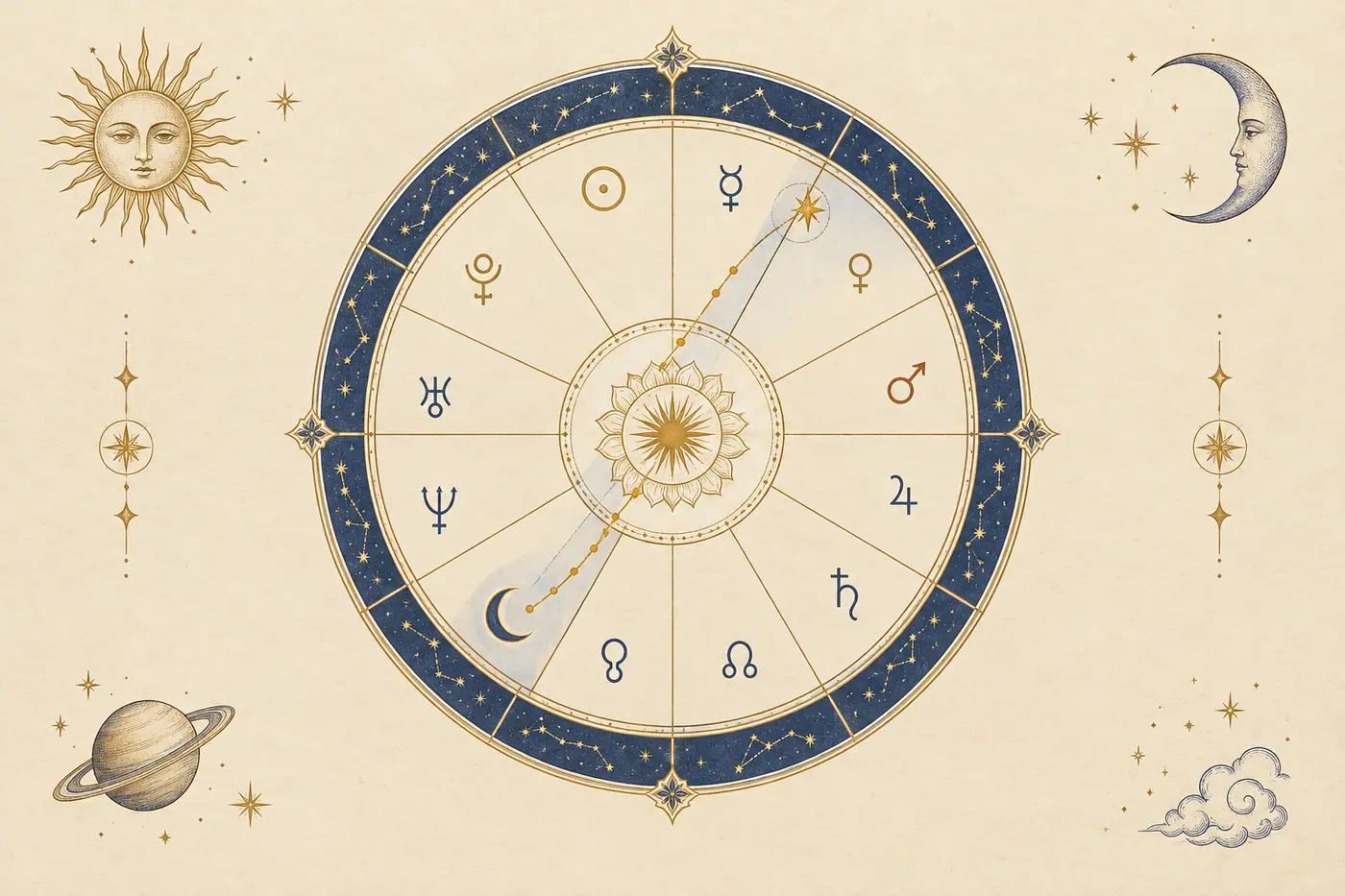
Vedic astrology for beginners starts with a birth chart, then builds an interpretation from several connected parts: signs, planets, houses, nakshatras, planetary periods, and transits. Learning these seven concepts will help you understand what a chart is describing without assuming that one placement dictates your future. Vedic astrology is also called Jyotisha; approaches vary across traditions and practitioners, so treat this guide as an orientation rather than a substitute for a full reading.
1. The birth chart (kundli): the map you read
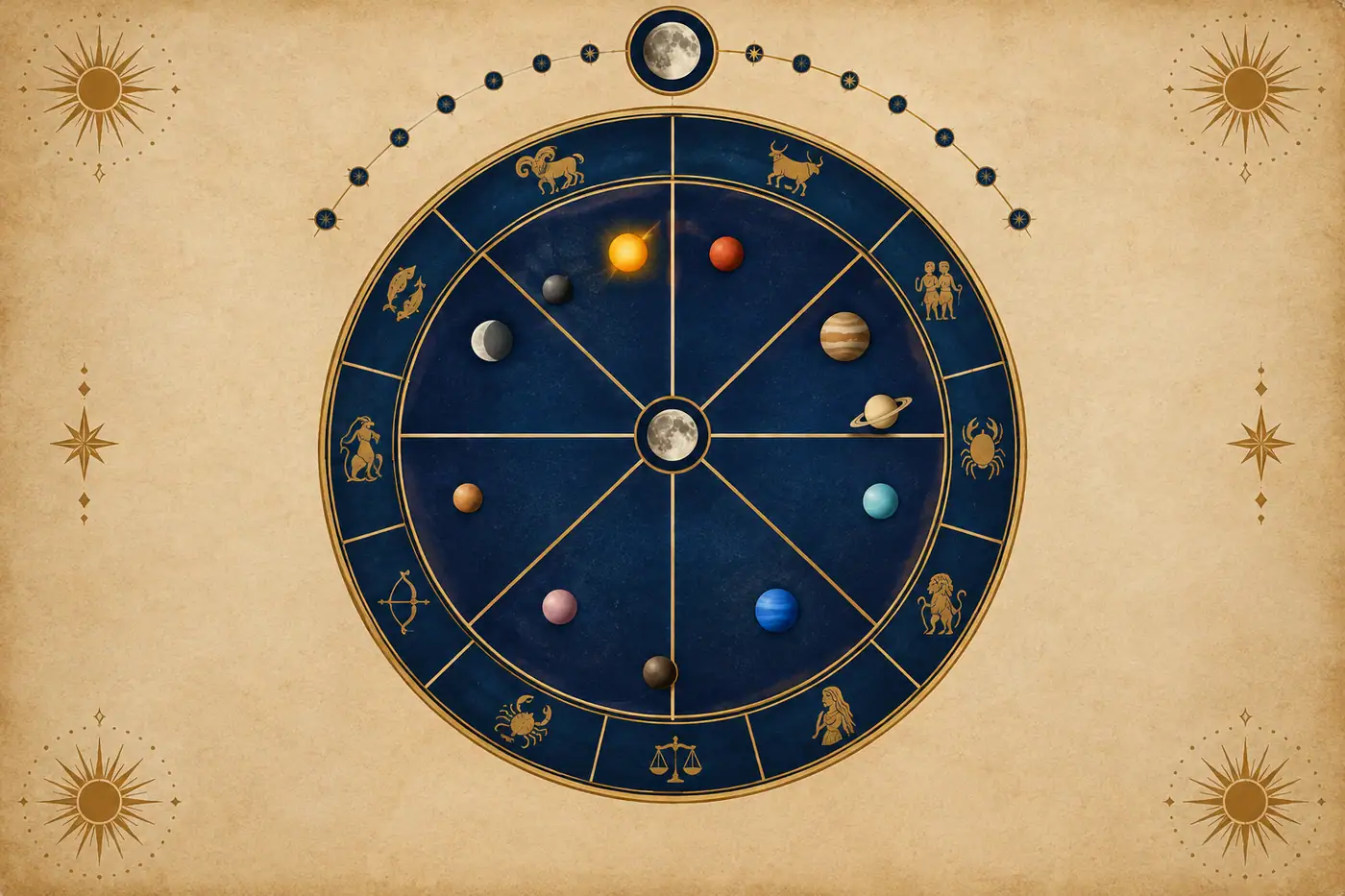
A Vedic birth chart, often called a kundli or janma kundali, represents the positions of celestial bodies for a particular birth time and place. Astrologers use those details to calculate the chart’s rising sign and planetary placements. Because the time and location are inputs, inaccurate birth details can change chart calculations, especially the ascendant and house arrangement.
For a beginner, think of the chart as a map, not a verdict. It provides a framework that an astrologer interprets using signs, houses, planetary relationships, and timing techniques. No single symbol should be taken as a complete description of a person or a guaranteed prediction of an event. If you want to understand the chart layout in more detail, see this step-by-step guide to reading a Vedic birth chart.
2. Rashi: the zodiac signs
Rashi is the Sanskrit term commonly used for a zodiac sign. In Vedic chart readings, people may refer to the Moon sign, the ascendant sign, or a planet’s sign, and these are not interchangeable. The Moon’s rashi is often prominent in horoscope interpretation, while the ascendant establishes the chart’s starting point for house placement.
When you see a sign named in a reading, ask which point in the chart it refers to. “Moon in a sign” and “ascendant in a sign” describe different placements and are interpreted in different ways. Avoid reducing a complete birth chart to a single sign label.
3. Grahas: the planets and chart factors
Vedic astrology commonly works with nine grahas: the Sun, Moon, Mars, Mercury, Jupiter, Venus, Saturn, Rahu, and Ketu. Rahu and Ketu are the lunar nodes, not physical planets like Mars or Saturn. In chart interpretation, grahas are treated as symbolic influences whose meanings depend on their position and relationships in the chart.
A useful beginner question is not simply “What does this planet mean?” but “Where is it placed, what sign and house is it in, and what else is connected to it?” Traditional descriptions associate grahas with different themes, but practitioners may interpret those themes differently. A planet’s label alone cannot explain an entire chart.
4. Bhavas: the twelve houses
Bhavas are the twelve houses of a chart. They are used to organize areas of life, such as identity, resources, communication, relationships, work, and other concerns, within a chart reading. The house meanings are interpreted alongside the sign on the house, its ruler, any planets placed there, and the wider chart context.
This is why a beginner should be cautious with statements such as “one house guarantees one outcome.” A house is one part of an interpretation, not a standalone promise. Different chart factors can support, complicate, or qualify an astrologer’s reading.
| Concept | What it describes | Beginner question |
|---|---|---|
| Rashi | The sign occupied by a chart point | Which planet or point is in this sign? |
| Graha | A planet or, for Rahu and Ketu, a lunar node used in interpretation | Where is it placed, and what is it connected to? |
| Bhava | A house or life area in the chart | Which house and house ruler are involved? |
| Nakshatra | A lunar mansion associated with a zodiac position | Which nakshatra is the Moon in? |
| Dasha | A planetary-period timing framework | What period is being considered, and alongside which chart factors? |
| Transit | Current planetary positions considered in relation to a birth chart | How does the current movement relate to the natal chart? |
5. Nakshatras: the lunar mansions
Nakshatras are commonly described as 27 divisions, or lunar mansions, along the zodiac. They provide a more detailed layer of interpretation than the twelve-sign framework. A reading may consider the Moon’s nakshatra, as well as the nakshatras occupied by other chart points.
For beginners, start by identifying the Moon’s nakshatra and learning how a practitioner explains it in context. Do not treat a short online description as a complete personality profile. The Moon’s sign, house, relationships to other grahas, and the rest of the chart all matter to a broader interpretation.
6. Dashas: planetary periods
A dasha is a planetary-period system used in Jyotisha to organize timing interpretations. The dasha framework most often encountered in introductory discussions is Vimshottari, but a practitioner may use other methods depending on their tradition and the question. A period is interpreted with the birth chart; it is not proof that a particular event must happen.
When someone mentions a dasha, ask which system they are using and how they connect the period to the natal chart. This helps separate a considered reading from a vague claim that a planet is simply “good” or “bad.” Timing techniques add context, not certainty.
7. Transits: current movements in context
Transits describe the current positions or movements of planets and how an astrologer relates them to a birth chart. A daily or monthly horoscope may use transits, but a broad forecast does not contain the same personal chart details as an individual reading. Different practitioners may also choose different reference points and interpret a transit differently.
Use transit content as a prompt for reflection rather than as an instruction to make a major decision. If a forecast raises a question about work, relationships, or wellbeing, combine it with practical information and your own judgment.
How to begin reading these concepts together
- Confirm your birth details. Use the most accurate birth time and location available, and note when the time is uncertain.
- Identify the chart basics. Find the ascendant, Moon sign, and the chart’s house layout before drawing conclusions.
- Look at a factor in context. For any planet or point, check its sign, house, and relevant relationships rather than relying on a one-line meaning.
- Add the Moon’s nakshatra. Treat it as another interpretive layer, not a replacement for the rest of the chart.
- Ask how timing is being assessed. If a reading discusses a dasha or transit, ask which chart factors support that interpretation.
- Keep predictions proportionate. Astrology is a traditional interpretive practice, not a guarantee. Avoid basing medical, legal, or financial decisions on a horoscope alone.
For a personalized starting point, you can visit HoroscopeDoc and explore a reading with your birth details. Check the details you enter and treat any interpretation as one perspective to consider, not a fixed outcome.
What you can do today
Write down your birth date, time, and place, noting any uncertainty about the time. Then learn to identify your ascendant, Moon sign, and Moon’s nakshatra before moving on to dashas and transits. This sequence makes the vocabulary easier to follow and helps you ask more useful questions about how a chart interpretation was reached.
