
If you want to choose a lucky number using a Vedic numerology approach, begin with your date of birth. The method commonly examines two numbers: your birth number, calculated from the day you were born, and your destiny number, calculated from your complete birth date. Reduce the relevant digits to a single number from 1 to 9, then interpret that number through traditional planetary symbolism.
This is a cultural and spiritual practice, not a guarantee that a particular number will create success, prevent difficulty, or predict an event. Use the result as a personal reflection prompt, not as a substitute for evidence, planning, professional advice, or responsible decision-making.
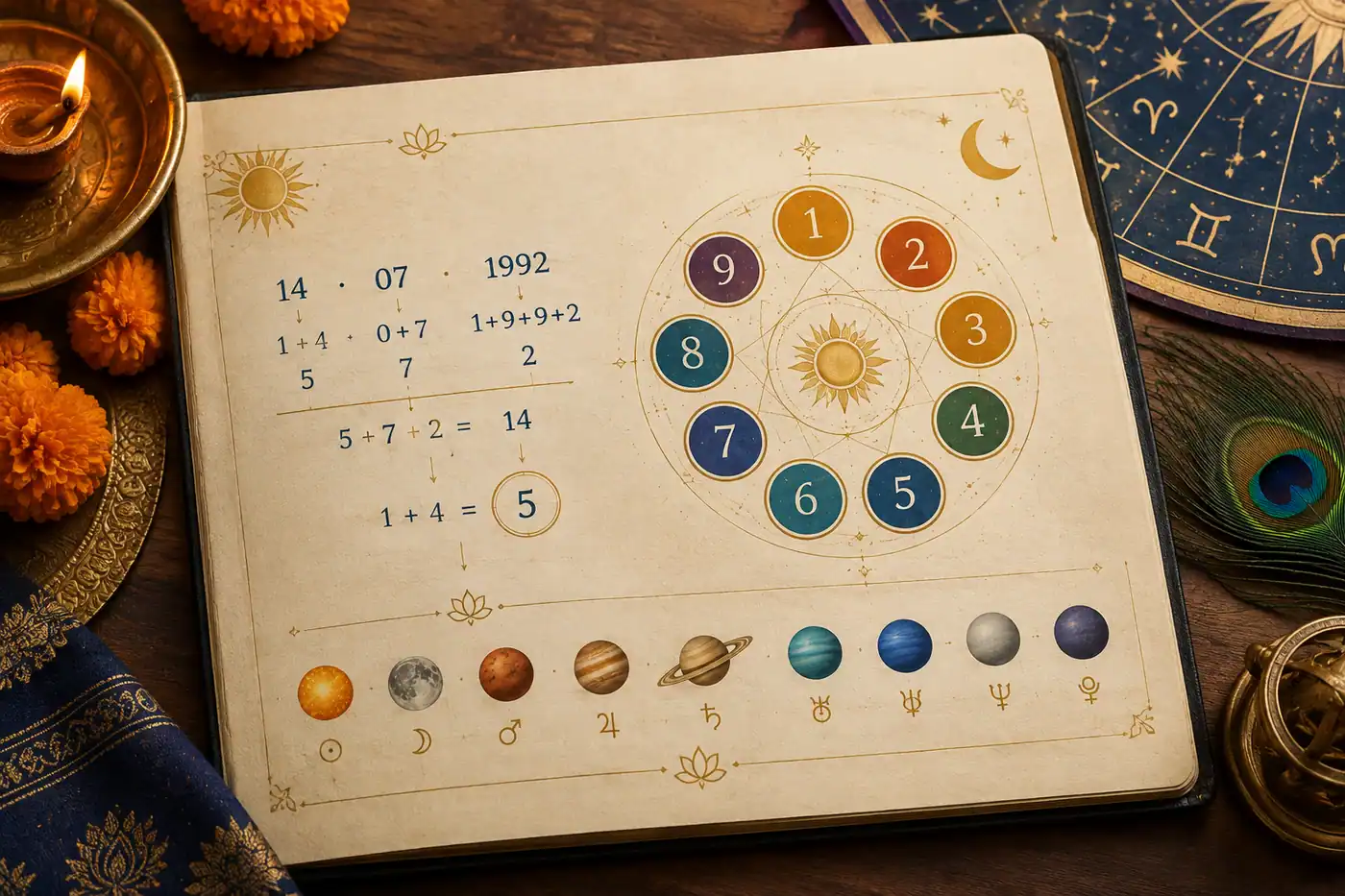
What does “lucky number” mean in Vedic astrology?
In popular Vedic numerology, numbers are associated with planetary qualities. A number may be considered personally favorable when it harmonizes with numbers derived from your birth date or, in some systems, with numbers connected to your name. Different practitioners use different rules, so there is no single universal formula for finding one correct lucky number.
It is also helpful to distinguish Vedic numerology from classical Jyotisha, the Sanskrit term commonly used for Indian astrology. Numerology works mainly with numbers and symbolic correspondences. A Jyotisha birth chart uses the birth date, exact time, and birthplace to calculate factors such as the ascendant, planetary positions, houses, and nakshatra. Some practitioners combine the two traditions, but they are not identical methods.
The simplest date-based exercise gives you two values:
- Birth number: the reduced number of the calendar day on which you were born.
- Destiny number: the reduced sum of every digit in your full date of birth.
For example, someone born on 24 August 1995 has a birth number of 6 because 2 + 4 = 6. Their destiny-number calculation adds all the date’s digits: 2 + 4 + 0 + 8 + 1 + 9 + 9 + 5 = 38; then 3 + 8 = 11, and finally 1 + 1 = 2. In this example, the birth number is 6 and the destiny number is 2.
How to calculate your Vedic birth number
Your birth number uses only the day of the month, not the month or year.
- Write down the day you were born.
- If it has two digits, add those digits together.
- Reduce the result again if necessary until you reach a number from 1 to 9.
| Birth date | Calculation | Birth number |
|---|---|---|
| 3rd | 3 | 3 |
| 14th | 1 + 4 = 5 | 5 |
| 27th | 2 + 7 = 9 | 9 |
| 31st | 3 + 1 = 4 | 4 |
Some numerology traditions preserve compound numbers such as 11 or 22, while others reduce them immediately. If you are following a particular teacher or family tradition, use that system consistently. For the straightforward exercise in this guide, reducing to 1 through 9 keeps the calculation easy to reproduce.
How to calculate your destiny number
The destiny number, sometimes called a life-path number in broader numerology discussions, uses the full date of birth.
- Write the day, month, and year as numbers.
- Add every digit together.
- Reduce the total to a single digit, unless your chosen tradition explicitly preserves a compound number.
Suppose the birth date is 7 November 1992:
7 + 1 + 1 + 1 + 9 + 9 + 2 = 30; 3 + 0 = 3.
The resulting destiny number is 3. Keep both results rather than choosing between them immediately. In popular interpretations, the birth number is often used to discuss personal expression, while the destiny number is used to discuss broader life themes. These are traditional interpretations, not scientifically established predictions.
Traditional planetary associations for numbers 1 to 9
Many Vedic numerology guides connect the nine single-digit numbers with planetary symbolism. The exact meanings and relationship rules vary by school, so use the following table as a traditional reference rather than a fixed personality test.
| Number | Traditional planetary association | Common symbolic themes |
|---|---|---|
| 1 | Sun | Independence, visibility, initiative |
| 2 | Moon | Feeling, receptivity, adaptability |
| 3 | Jupiter | Learning, guidance, expansion |
| 4 | Rahu | Unconventional thinking, disruption, ambition |
| 5 | Mercury | Communication, movement, analysis |
| 6 | Venus | Harmony, beauty, affection |
| 7 | Ketu | Introspection, spirituality, investigation |
| 8 | Saturn | Discipline, responsibility, persistence |
| 9 | Mars | Courage, energy, action |
These associations should not be read as fixed personality labels. A number associated with Saturn does not mean that every person with that number will experience hardship, and a number associated with Venus does not guarantee relationship success. In traditional Jyotisha, the wider birth chart, including planetary dignity, house placement, aspects, and the Moon’s nakshatra, is considered more detailed than a single number.
How to choose between your birth number and destiny number
If your birth number and destiny number are different, do not treat one as automatically correct and the other as wrong. Instead, use them for different reflective questions:
- Use your birth number when reflecting on how you approach situations or present yourself.
- Use your destiny number when reflecting on long-term themes suggested by your complete birth date.
- When choosing one personal number, start with the number that feels more relevant to the question you are asking.
- If the numbers seem to conflict, keep both in your notes and consult a complete chart rather than forcing a simple answer.
For instance, someone with a birth number of 5 and a destiny number of 8 might use 5 as a reminder to communicate clearly and 8 as a prompt to stay disciplined. The point is not to predict a guaranteed result; it is to turn an abstract tradition into a practical reflection exercise.
How can you use a lucky number responsibly?
Once you have calculated your numbers, use them in low-stakes, personal ways. You might select a number for a journaling prompt, meditation theme, personal goal, or reminder of a quality you want to cultivate. You could also use it as a creative theme for the day, provided the choice does not replace practical planning.
Do not use a numerological number as the sole basis for financial decisions, medical choices, legal matters, gambling, or major relationship decisions. A number cannot replace evidence, informed consent, careful budgeting, or qualified advice. Responsible use keeps the practice meaningful without turning symbolism into certainty.
Why a full birth chart can add context
A date-based number calculation uses only a small part of the information traditionally examined in Jyotisha. A Vedic birth chart, or janma kundali, also considers the time and place of birth. It may be used to examine the ascendant, the Moon sign, planetary placements, houses, nakshatra, and dashas. Those calculations require accurate birth details and belong to a broader interpretive system than a single lucky number.
If you want to explore that broader context, use HoroscopeDoc for a personal Vedic reading. Have your birth date, birth time, and birthplace ready if you know them, and treat any interpretation as guidance for reflection rather than a guaranteed forecast.
What to do today
- Write down your full date of birth.
- Calculate your birth number from the day alone.
- Calculate your destiny number from every digit in the date.
- Read the planetary associations as traditional symbolism, not proof.
- Choose one practical quality, such as communication, patience, or discipline, to focus on today.
- Record what you notice without assuming that the number caused the result.
Frequently asked questions
Is a lucky number the same as a Moon sign or Rashi?
No. A lucky number is derived through a numerology method. A Rashi, commonly referring to the Moon sign in Vedic astrology, is calculated from the Moon’s astronomical position at birth and requires birth details. They should not be treated as interchangeable.
Should I use my birth number or destiny number?
There is no universally accepted answer. Use the birth number for a simple reflection on personal expression and the destiny number for broader date-based themes. If you want a more detailed interpretation, examine a complete birth chart instead of forcing one number to answer every question.
Can a lucky number guarantee success?
No. Traditional numerology offers symbolic interpretations, not guarantees. Use a number only for low-stakes reflection and make important choices using relevant evidence and qualified professional guidance.
What if I do not know my birth time?
You can still calculate the date-based numbers described here. However, a full Vedic chart may be less precise without a reliable birth time, particularly for the ascendant, houses, and some timing techniques.
Next step: calculate both numbers now, write down the quality you want to practice today, and then explore your broader birth-chart context with a personal HoroscopeDoc reading.
