
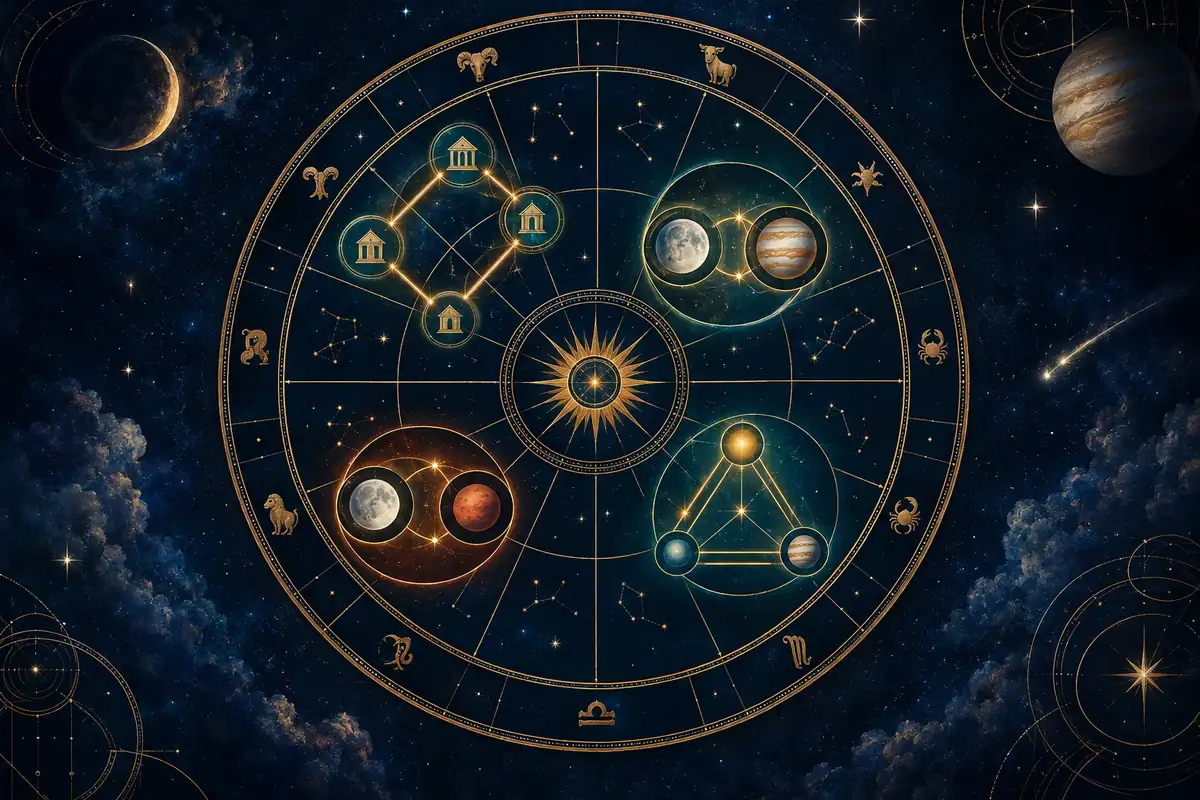
In Vedic astrology, wealth yogas are combinations of planets and houses traditionally read as indications of earning capacity, resources, opportunity, or achievement. They are not guarantees of wealth. This guide explains five commonly discussed combinations, Dhana Yoga, Lakshmi Yoga, Gaja Kesari Yoga, Chandra-Mangala Yoga, and Raja Yoga, and the chart factors an astrologer would check before interpreting them. Use them as a symbolic framework for reflection, not as a substitute for financial planning or professional advice.
What astrologers mean by a wealth yoga
Yoga means a combination or association in a chart. In a Vedic birth chart, a yoga may be formed by house lords connecting through placement, aspect, conjunction, or other traditional rules. The houses most often examined for material resources include the second (accumulated resources and family), fifth (judgment, creativity, and past merit in traditional readings), ninth (fortune and support), tenth (work and public contribution), and eleventh (gains and networks). The ascendant and its ruler provide essential context.
There is no single universal checklist that every Vedic lineage uses in exactly the same way. Definitions can vary by text, school, and chart method. A yoga should therefore be identified with its stated rules, not inferred from one attractive placement or a horoscope headline.
Five wealth and success yogas to know
| Yoga | Traditional association | What to examine |
|---|---|---|
| Dhana Yoga | Resources, income, or accumulation | Connections among lords of the 2nd, 5th, 9th, 10th, and 11th houses |
| Lakshmi Yoga | Fortune, prosperity, and support | Strength and relationship of the 9th lord and the ascendant lord |
| Gaja Kesari Yoga | Standing, judgment, and recognition | Jupiter’s position from the Moon, plus both planets’ condition |
| Chandra-Mangala Yoga | Enterprise, initiative, and commercial drive | A traditional association between the Moon and Mars |
| Raja Yoga | Authority, responsibility, or advancement | Links between angular-house and trinal-house lords |
1. Dhana Yoga
Dhana means wealth or resources. Dhana Yoga is a broad label for combinations that connect houses associated with resources, fortune, work, and gains. Astrologers commonly look for links involving the second and eleventh lords, and may also assess the fifth, ninth, and tenth lords. A connection might occur through conjunction, mutual aspect, or one lord occupying a house ruled by another, depending on the method being used.
For a useful reading, ask which specific houses and lords form the connection and whether those planets are supported or challenged elsewhere in the chart. The label alone does not say how much someone will earn or when. It is a traditional interpretive signal, not a financial forecast.
2. Lakshmi Yoga
Lakshmi Yoga is traditionally associated with prosperity and good fortune. One commonly described formulation emphasizes a strong ninth-house lord and a capable ascendant lord, with the ninth lord placed in a favorable position. Different astrological sources and traditions may specify additional conditions, so the name should not be applied without stating which definition is being used.
In practice, astrologers consider whether the relevant planets are strong in the chosen chart system and how the rest of the chart modifies the promise. The symbolic emphasis is on favorable support and resources; it does not mean effortless success or guaranteed material comfort.
3. Gaja Kesari Yoga
Gaja Kesari Yoga is commonly described through Jupiter’s position in a kendra, an angular relationship, from the Moon. Traditional interpretations associate it with judgment, respect, learning, or prominence. It is often included in discussions of success because recognition and sound decisions can matter in a person’s working life, but it is not simply a “money yoga.”
Check the Moon and Jupiter themselves: their sign placement, house position, and other connections affect how astrologers interpret the combination. Some traditions also apply qualifications beyond the basic placement. Avoid treating a quick chart-app label as a complete analysis.
4. Chandra-Mangala Yoga
Chandra-Mangala Yoga refers to a traditional association between the Moon and Mars. Depending on the method, this may involve conjunction or another relationship. Interpretations often emphasize initiative, decisiveness, enterprise, or a strong drive to act. Such qualities can be relevant to work and business, but the combination may also be read as emotionally forceful or impulsive.
That nuance matters: the yoga should not be presented as a promise of business profit. An astrologer would consider the condition of both planets, the houses they rule and occupy, and whether other chart factors support steadiness and good judgment.
5. Raja Yoga
Raja Yoga is associated with authority, achievement, status, or advancement. A widely used principle is a connection between lords of kendras (angular houses) and trikonas (trinal houses). The exact combinations and results depend on the ascendant, the planets involved, their strength, and the broader chart.
Raja Yoga is not necessarily a direct indicator of money. It may symbolize opportunity, responsibility, or recognition, which can take different forms in a person’s life. Read it alongside the chart’s resource and income indicators rather than equating status with wealth.
How to assess a wealth yoga without overreading it
- Confirm the birth details. Birth time and place affect chart calculations, especially the ascendant and house layout. If the recorded time is uncertain, note that before drawing conclusions.
- Identify the exact rule. Ask which planets, house lords, or relationships form the yoga. A label without a rule is too vague to verify.
- Check the planets’ condition. Placement, strength, aspects, conjunctions, and other chart factors can modify a traditional interpretation.
- Read the whole chart. Consider the ascendant, relevant houses and lords, and contradictory or supporting combinations. One yoga should not be isolated from the rest.
- Separate symbolism from decisions. Astrology can be meaningful as a reflective tradition, but it cannot establish investment returns, income, or future events with certainty.
Why a yoga is not a promise of wealth
Astrological combinations are interpreted within a belief system, and practitioners may disagree about definitions and emphasis. A chart placement is not independently verifiable evidence that a person will become wealthy. Real financial outcomes are shaped by many personal and external circumstances, and a horoscope cannot replace budgeting, career research, or qualified financial advice.
Be especially cautious of anyone who uses a yoga label to pressure you into buying a costly remedy, gemstone, or investment. No chart combination can guarantee that a purchase will produce a financial result. If you want an astrological perspective, ask for the reasoning behind the interpretation and treat it as one lens rather than a directive.
Frequently asked questions
Which Vedic yoga is associated with wealth?
Dhana Yoga is the broadest label commonly associated with resources or accumulation. Lakshmi Yoga is associated with prosperity, while other combinations may relate to opportunity, enterprise, recognition, or advancement. Definitions and interpretations vary, and none guarantees wealth.
Does Gaja Kesari Yoga mean someone will become rich?
No. It is commonly interpreted in relation to Jupiter’s angular position from the Moon and can be associated with qualities such as judgment, learning, or recognition. Astrologers consider the whole chart; the yoga alone is not a financial prediction.
Can I identify these yogas from my Moon sign alone?
Usually not. Identifying a yoga may require the full birth chart, including the ascendant, house placements, planetary relationships, and the specific rules being applied. Accurate birth time and place can matter for chart calculation.
What to do today
If you are curious about wealth yogas, write down your confirmed birth details and the specific combination you want to understand. Then ask an astrologer to explain the relevant house lords, the rule being applied, and what factors could qualify the reading. You can also start with a personal Vedic reading from HoroscopeDoc and use it to explore your chart’s symbolism. Keep financial choices grounded in your goals, research, and practical circumstances.
