
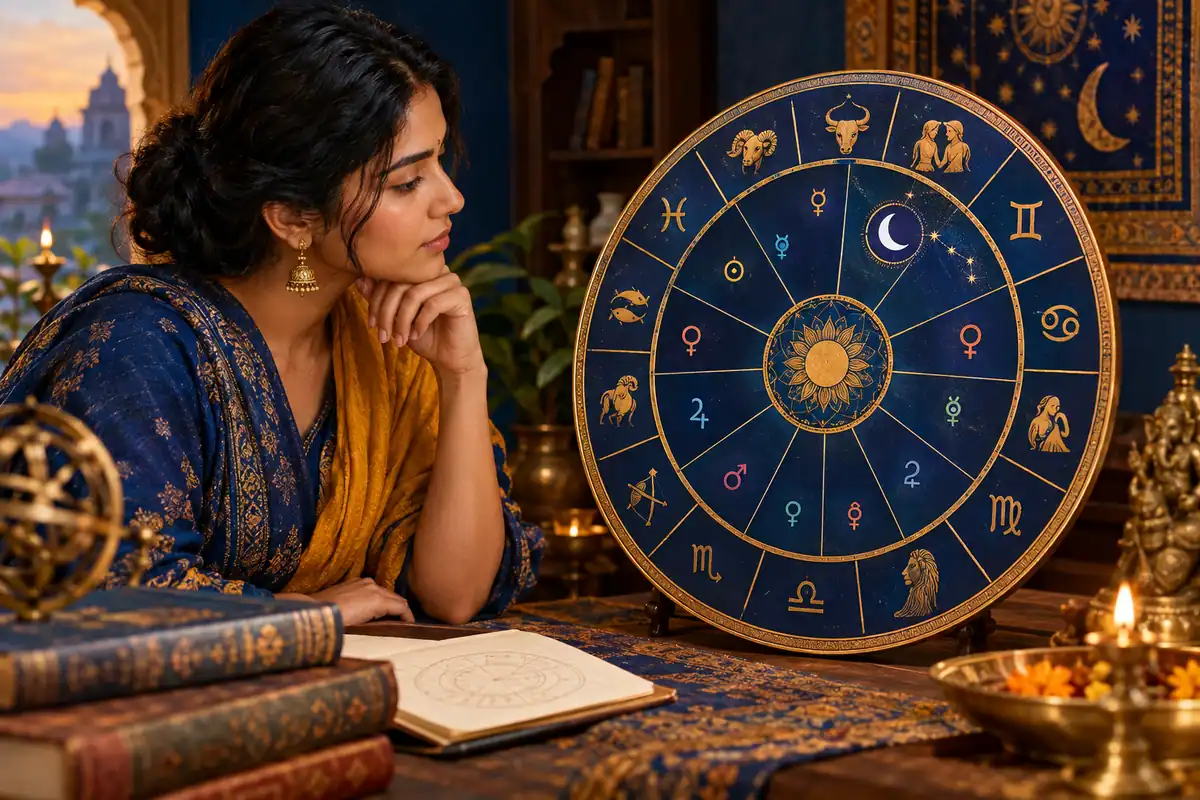
Daily horoscope accuracy in Vedic astrology depends on the kind of horoscope you are reading and how much of your birth chart it uses. A generalized forecast usually describes broad themes for a Moon sign or zodiac sign. A personalized prediction can consider your birth date, exact birth time, birthplace, natal placements, current transits, and dasha period. Neither approach guarantees a fixed event, but a personalized reading can provide more relevant context than a one-size-fits-all forecast.
What does “accuracy” mean in a daily horoscope?
People use the word accurate in different ways. Some expect a horoscope to predict a specific event, such as receiving a message or changing jobs. Others want it to describe the emotional tone of a day, identify a useful area of focus, or suggest when to act cautiously.
Vedic astrology traditionally interprets tendencies, timing, and patterns rather than removing personal choice. A daily prediction may be useful when it helps you notice a recurring theme or make a considered decision. It becomes less useful when it is treated as an unavoidable promise.
A practical standard is to ask whether the prediction is:
- Relevant: Does it use the correct sign, chart, and time period for you?
- Specific enough to test: Does it explain the area of life involved without pretending to know every detail?
- Responsible: Does it leave room for judgment instead of making absolute claims?
- Actionable: Does it offer a sensible way to respond today?
How a generalized Vedic daily horoscope is made
Many daily Vedic horoscopes are organized by Moon sign, also called rashi. In Jyotisha, the Moon is important for the mind, habits, emotional responses, and day-to-day experience. A forecast may examine where current planets are moving in relation to that sign and describe possible themes such as communication, work, relationships, expenses, or rest.
Some publications instead organize content by the ascendant or by a Western-style Sun sign. Those systems are not interchangeable. If a forecast is labeled Vedic but does not explain which sign it uses, readers should check the method before deciding how personally relevant it is.
A broad daily forecast can be helpful as a reflective prompt. However, it applies the same planetary backdrop to many people. It cannot account for the different natal charts, life circumstances, dasha periods, and choices of every reader born under the same sign.
Why your Moon sign matters
The Moon sign is one reason two people may experience the same transit differently. A daily Vedic forecast based on the Moon sign considers the current planetary positions from the Moon’s placement in the natal chart. This can make the reading more personally oriented than a generic sign column.
It still has limits. A Moon-sign forecast does not automatically show your ascendant, house placements, planetary strength, divisional charts, or active dasha. It is therefore better understood as one layer of interpretation rather than a complete personal prediction. If you need to verify your rashi first, use a Vedic chart reading from HoroscopeDoc.
Transits add timing, not certainty
A transit describes a planet’s current movement in relation to positions in a birth chart. Vedic astrologers may examine the transits of the Moon, Sun, Jupiter, Saturn, Mars, and the lunar nodes when discussing daily or short-term developments.
The fast-moving Moon can be used for day-to-day mood and timing themes. Slower planets may describe longer periods of pressure, learning, expansion, restructuring, or change. A transit can indicate that a topic deserves attention, but it does not by itself prove that one specific event will happen.
Interpretation also depends on the natal chart. The same Saturn transit may emphasize different houses or life areas for people with different ascendants. The same Jupiter transit may feel supportive in one chart and more complicated in another because of natal placements and broader timing factors.
Dashas explain why timing differs between people
Vedic astrology often uses dashas, or planetary periods, to organize longer-term timing. A dasha sequence assigns prominence to particular planets for defined periods according to the chosen system. The active period is interpreted alongside the natal chart and current transits.
This is a major difference between a short generalized horoscope and a personal reading. Two people may share a Moon sign and face similar transits, yet be in different dasha periods. Their priorities, opportunities, and pressures may therefore be interpreted differently.
Dasha analysis requires accurate birth information and a consistent calculation method. It should not be presented as a simple daily slogan or as a guarantee of a predetermined outcome.
Generalized versus personalized Vedic predictions
| Type of forecast | What it can help describe | What it usually cannot establish |
|---|---|---|
| General sign forecast | Broad themes, reflective prompts, and common transit topics | A precise event, personal timing, or the full context of your chart |
| Moon-sign forecast | Daily emotional and practical themes viewed from the rashi | All house, ascendant, dasha, and natal-chart factors |
| Ascendant-based forecast | Possible life areas activated by current planetary movement | How planetary periods and individual natal strengths modify the result |
| Personal birth-chart reading | Chart-specific patterns, timing factors, and areas for reflection | Certainty about another person’s actions or an unavoidable future |
Birth-time accuracy affects the reading
Vedic chart interpretation commonly uses the birth date, birth location, and birth time. The ascendant changes with time, so an incorrect or approximate birth time can affect houses and other calculations. A difference in recorded time may matter particularly when the ascendant or a timing boundary is close to changing.
This does not mean a reading with uncertain birth information is worthless. It means the interpreter should identify the uncertainty and avoid presenting house-based conclusions as exact. If the birth time is unknown, some practitioners use alternative methods, but those methods should be clearly explained rather than hidden behind confident language.
How to judge whether a daily horoscope is useful
- Identify the system. Check whether the forecast uses a Vedic Moon sign, ascendant, Sun sign, or another framework.
- Look for context. A useful explanation connects a prediction to a transit, natal factor, or stated interpretive method.
- Separate themes from promises. “Review communication carefully” is different from claiming that a particular person will call.
- Compare it with your circumstances. Use the reading as a prompt, not as a substitute for facts, professional advice, or direct communication.
- Track patterns over time. Note what was predicted, what actually happened, and whether the guidance was specific enough to be meaningful.
What a daily horoscope should not replace
Astrology can support reflection, but it should not replace medical care, legal advice, financial planning, safety decisions, or honest conversations. Avoid any reading that uses fear to pressure you into purchasing a remedy, making a major decision, or accepting an absolute outcome.
Remedies and spiritual practices may be meaningful within a person’s tradition, but they should be approached thoughtfully. A responsible horoscope gives you room to choose, verify information, and seek qualified help when the matter is outside astrology’s proper role.
What you can do today
Start by checking which sign your daily horoscope uses. If you know your birth details, compare a Moon-sign forecast with a fuller Vedic birth-chart interpretation and notice where the added context changes the discussion. You can explore a personal chart through HoroscopeDoc, then use the result as a framework for reflection rather than a fixed script.
For today, write down one forecast theme, one concrete action you control, and one fact you still need to verify. That simple habit keeps astrology useful: it turns a prediction into a question, a question into awareness, and awareness into a deliberate choice.
Frequently asked questions
Is a Vedic daily horoscope guaranteed to come true?
No. It is an interpretive tradition that describes possible themes and timing, not a guaranteed event.
Is a Moon-sign forecast more personal than a generic horoscope?
Usually it adds one relevant chart factor, but it still does not replace the ascendant, houses, dashas, and natal placements.
Why does birth time matter?
Birth time helps calculate the ascendant and houses. Uncertainty can limit how confidently those factors should be interpreted.
What should I do next?
Identify the horoscope’s method, then run a Vedic birth chart with your birth details and use the result for reflection—not as a substitute for qualified professional advice.
