
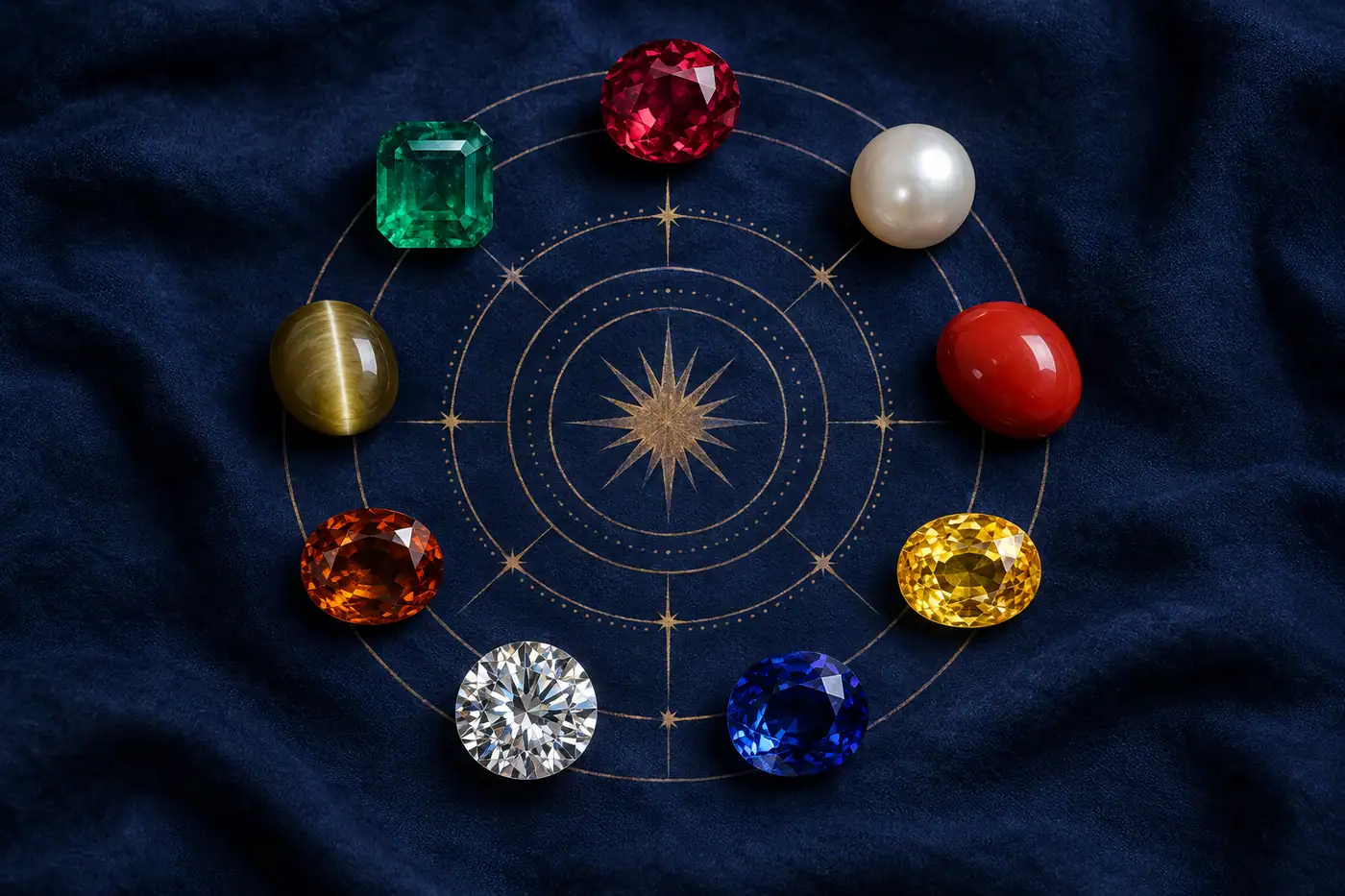
If you are looking for the best gemstones for zodiac signs in Vedic astrology, begin with a traditional sign-to-gemstone association—but do not treat it as a complete prescription. Vedic gemstone practice links gems with planets, and your ascendant, Moon sign, planetary strength, house placement, and current planetary periods can all matter. The guide below is therefore a broad reference, not a guarantee that a particular stone will suit everyone born under a sign.
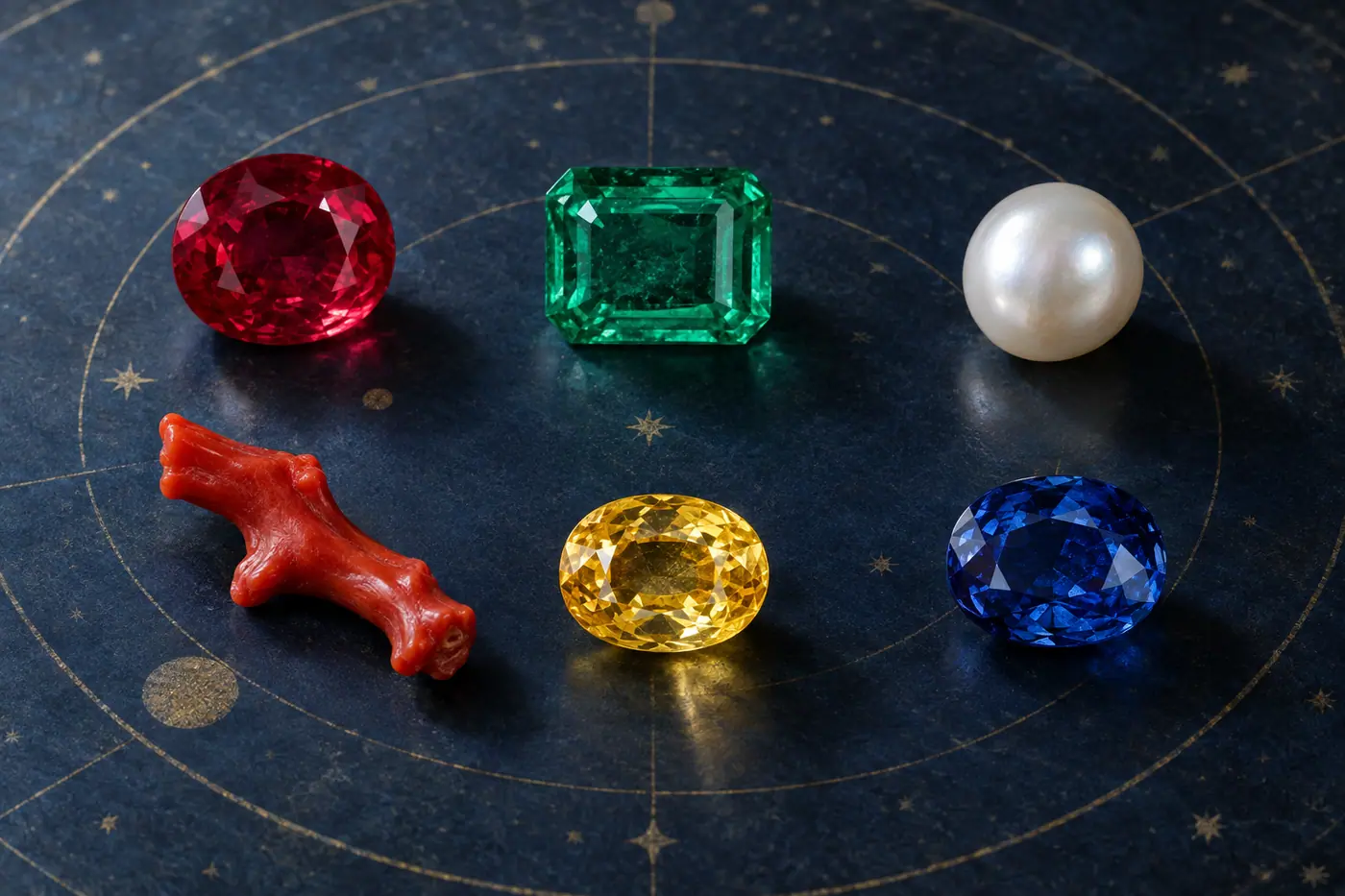
Traditional gemstone guide by zodiac sign
The table uses the twelve commonly used zodiac signs and their traditional ruling planets. In Vedic astrology, the gemstone listed is generally connected with that ruling planet. Different astrologers may refine or change the recommendation after examining a complete birth chart.
| Zodiac sign | Traditional ruler | Commonly associated gemstone | Traditional symbolism |
|---|---|---|---|
| Aries (Mesha) | Mars | Red coral | Drive, courage, initiative |
| Taurus (Vrishabha) | Venus | Diamond or white sapphire | Beauty, harmony, creative refinement |
| Gemini (Mithuna) | Mercury | Emerald | Communication, learning, discernment |
| Cancer (Karka) | Moon | Pearl | Emotional sensitivity, care, receptivity |
| Leo (Simha) | Sun | Ruby | Vitality, confidence, leadership |
| Virgo (Kanya) | Mercury | Emerald | Analysis, skill, practical intelligence |
| Libra (Tula) | Venus | Diamond or white sapphire | Balance, aesthetics, partnership |
| Scorpio (Vrishchika) | Mars | Red coral | Resolve, stamina, focused action |
| Sagittarius (Dhanu) | Jupiter | Yellow sapphire | Wisdom, growth, teaching |
| Capricorn (Makara) | Saturn | Blue sapphire | Discipline, responsibility, patience |
| Aquarius (Kumbha) | Saturn | Blue sapphire | Persistence, structure, long-term effort |
| Pisces (Meena) | Jupiter | Yellow sapphire | Faith, learning, generosity |
These are traditional correspondences, not promises of results. They also do not cover every gemstone used in Jyotisha. Hessonite is commonly associated with Rahu, while cat’s-eye is associated with Ketu; those stones are usually considered through the individual chart rather than assigned simply from a twelve-sign list.
Why the zodiac sign alone may not be enough
A sign-based recommendation usually starts with the sign of the Sun or the sign shown in a popular horoscope. Vedic astrologers may instead give particular importance to the ascendant, its ruler, and the Moon sign. The same planet can be helpful in one chart and complicated in another because its houses, dignity, aspects, conjunctions, and planetary period differ.
That is why a gemstone traditionally connected with your sign is not automatically the right stone for you. For example, blue sapphire is associated with Saturn, but a general Capricorn or Aquarius association does not by itself establish that continuous blue-sapphire wear is appropriate. The same caution applies to ruby, yellow sapphire, red coral, and the node gemstones. A personal interpretation should come before a strong or expensive purchase.
Vedic planetary gemstones versus popular birthstones
Popular birthstone lists usually assign a stone to a birth month. Vedic gemstone practice works differently: its core logic is planetary symbolism. The gem is selected to represent, strengthen, or harmonize with a planet according to a chart-based judgment.
This distinction explains why two guides can give different answers without either using the same method. A month-based birthstone guide may recommend one stone for everyone born in a period, while a Vedic reading may consider the ascendant, Moon sign, planetary periods, and the condition of the relevant planet. If your goal is an astrological remedy, do not assume that a jewelry birthstone and a planetary gemstone serve the same purpose.
How to choose a gemstone more responsibly
- Confirm the chart data. Use the correct birth date, exact or carefully estimated birth time, and birthplace. A changed birth time can alter the ascendant and house placements.
- Identify which sign you are using. Be clear whether a recommendation came from your Sun sign, Moon sign, ascendant, or a general horoscope.
- Ask which planet the stone represents. The important question is not only “Which stone matches my sign?” but also “Why is this planet being emphasized in my chart?”
- Check the complete chart. Consider the planet’s house ownership, placement, strength, aspects, conjunctions, and current dasha or transit context rather than relying on a one-line list.
- Separate symbolism from guarantees. A gemstone is a traditional spiritual or astrological practice. It should not replace medical care, financial judgment, legal advice, or practical action.
- Consider the purchase carefully. Verify what the stone actually is, ask about treatments and documentation, and avoid spending beyond your means because of a prediction.
What about Navaratna jewelry?
Navaratna jewelry traditionally combines nine gemstones connected with the nine planetary influences used in Jyotisha. It is often presented as a balanced planetary arrangement, but “all nine stones” does not remove the need for judgment. A complete chart still provides context, and people should be cautious about treating a symbolic piece as a universal remedy.
What you can do today
Write down your birth date, birth time, and birthplace, then note whether your current gemstone recommendation came from your Sun sign, Moon sign, or ascendant. Compare that recommendation with a full Vedic chart before buying or wearing a strong planetary gem. For a personal starting point, you can use HoroscopeDoc to explore a Vedic birth-chart reading and ask more specific questions about gemstone symbolism in your chart.
The most useful answer is rarely just the name of a stone. It is an explanation of which planet the stone represents, why that planet matters in your chart, and how the recommendation fits your present goals. Use the sign-by-sign table as orientation, then move to chart-based guidance before making a serious decision.
