
Rahu Ketu transit effects are interpreted in Vedic astrology as shifts in the areas of life connected with desire, disruption, detachment, and redirection. Rahu may intensify ambition, novelty, or uncertainty, while Ketu may reduce interest in familiar goals and turn attention inward. The effect is not the same for everyone: a useful interpretation requires your natal chart, the houses involved, the Moon sign, and the current dasha or planetary period.
What Are Rahu and Ketu?
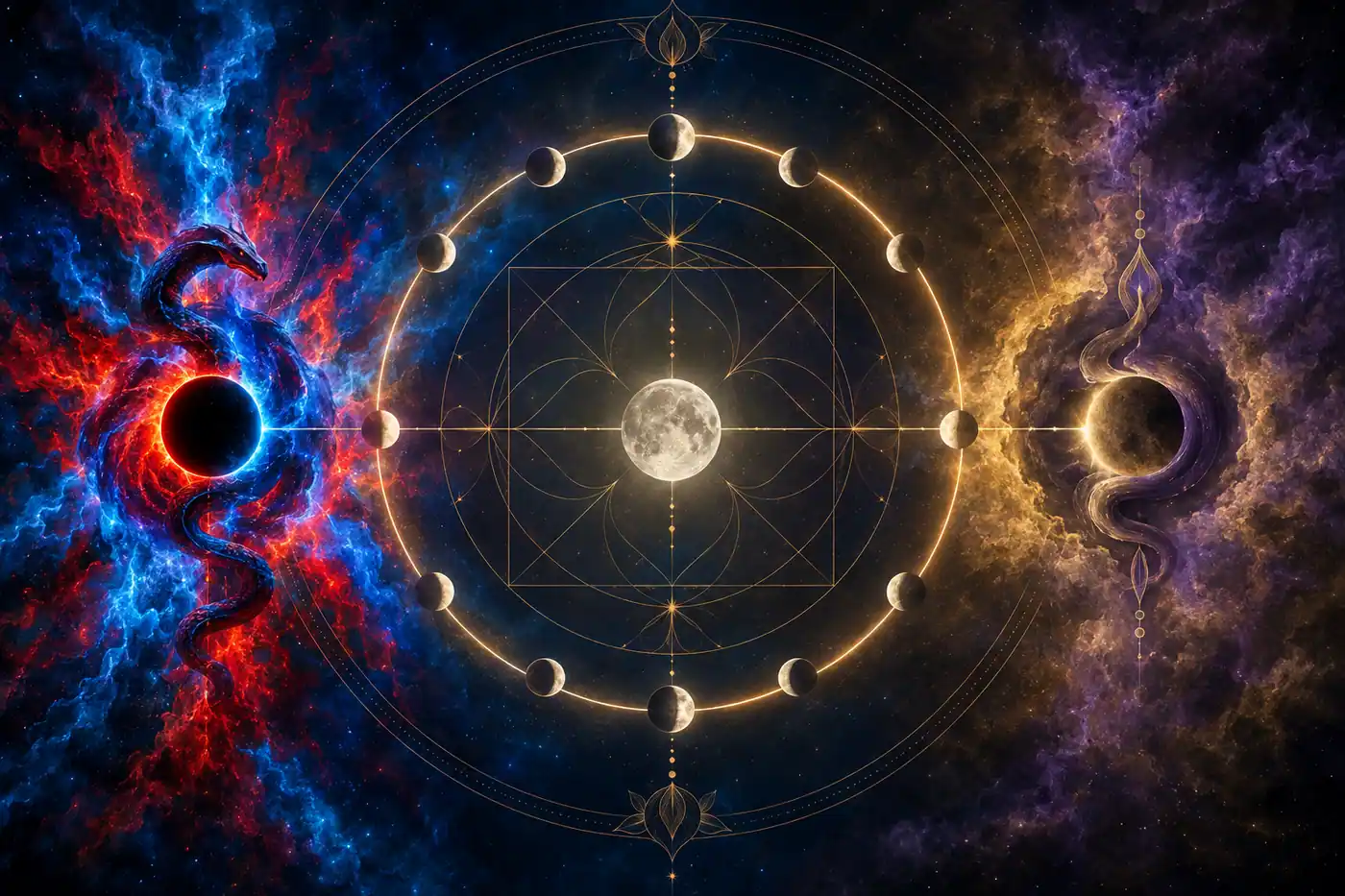
Rahu and Ketu are the north and south lunar nodes: mathematical points where the Moon’s orbit intersects the Sun’s apparent path. In Jyotisha, they are treated as powerful shadow planets even though they are not physical planets. They always remain opposite one another in the chart.
Astrologers commonly associate Rahu with appetite, amplification, experimentation, ambition, foreign or unconventional experiences, and the desire to cross boundaries. Ketu is associated with separation, simplification, inwardness, instinct, spiritual inquiry, and reduced attachment. These are symbolic themes, not fixed predictions. A Rahu period does not automatically produce success or confusion, and a Ketu period does not automatically produce loss.
Why a Transit Cannot Be Read from a Sign Alone
When people search for Rahu Ketu transit effects, they often find sign-based forecasts. Those can be a general starting point, but they leave out the details that make a chart interpretation personal. An astrologer typically considers several layers together:
| Chart factor | What it helps describe |
|---|---|
| Natal house | The life area where the node’s underlying pattern already operates. |
| Transit house | The area currently receiving emphasis as Rahu and Ketu move through the sky. |
| Sign | The style or environment through which the node expresses itself. |
| Moon sign | How the transit may be experienced emotionally and psychologically in a traditional reading. |
| Ascendant | How the transit is related to identity, body, direction, and visible life circumstances. |
| Dasha | The timing context that may make a natal promise more prominent or less noticeable. |
| Conjunctions and aspects | Which planets and chart topics are drawn into the interpretation. |
For that reason, two people can experience the same nodal transit in very different ways. One person may feel pressure to change a career direction; another may become more selective about relationships or social commitments. The chart does not remove personal choice, and astrology should not be used to make high-stakes decisions without practical evidence.
Common Rahu Transit Themes
Rahu often points to an area where attention grows quickly. You may become curious about a new field, seek recognition, pursue a different social circle, or feel dissatisfied with an established routine. In constructive circumstances, this can encourage research, innovation, and the courage to leave a narrow definition of what is possible.
The same symbolism can become difficult when enthusiasm outruns judgment. Commonly described challenges include overpromising, chasing appearances, reacting to rumors, or treating novelty as proof of value. Rahu’s theme is not simply “bad luck”; it is heightened appetite. The practical question is whether the goal is supported by clear information and sustainable effort.
Common Ketu Transit Themes
Ketu often marks an area where attachment loosens. You might lose interest in a role that once defined you, prefer solitude, question an inherited belief, or discover that external achievement no longer feels sufficient. This can support study, contemplation, simplification, and spiritual practice.
It can also feel like uncertainty or disconnection. A person may withdraw before understanding what they actually need, neglect a useful responsibility, or mistake temporary frustration for a final answer. During a Ketu-themed period, a slower review can be more useful than an abrupt decision.
How Houses Add Meaning
House interpretations provide a practical framework, but they should not be treated as promises. In broad terms, astrologers may examine themes such as:
- First house: identity, appearance, vitality, and the way you approach life.
- Second house: speech, family patterns, stored resources, and values.
- Third house: communication, skills, initiative, and short journeys.
- Fourth house: home, emotional foundations, property, and inner security.
- Fifth house: learning, creativity, children, romance, and personal expression.
- Sixth house: work routines, service, health habits, and practical problems.
- Seventh house: partnerships, contracts, and one-to-one dealings.
- Eighth house: shared resources, vulnerability, research, and major transitions.
- Ninth house: teachers, higher learning, ethics, travel, and belief systems.
- Tenth house: career direction, reputation, authority, and public responsibilities.
- Eleventh house: networks, gains, communities, and long-term aims.
- Twelfth house: retreat, expenditure, foreign settings, sleep, and release.
The node’s result also depends on the house lord, planets connected to the house, dignity, and dasha timing. A single “Rahu in the tenth house” sentence cannot replace that full context.
Rahu Ketu Transit Effects in Daily Life
Rather than asking only whether a transit is fortunate or difficult, track the pattern it is bringing to your attention. Useful questions include:
- Where am I seeking certainty, approval, or rapid progress?
- Which new opportunity has enough evidence behind it, and which one is only exciting?
- What responsibility am I avoiding because I feel detached?
- Are changes in sleep, stress, spending, or relationships calling for practical support?
- What information would I need before making an irreversible decision?
This approach turns astrology into a reflection tool. It also protects against fatalistic readings. A transit can describe a period of emphasis in a traditional system; it cannot guarantee a specific event.
Traditional Remedies and Grounded Responses
Remedies vary by lineage and should be matched to the complete chart rather than selected from a generic list. Traditional practitioners may recommend prayer or mantra practice, meditation, charitable service, respect for teachers and elders, simpler routines, or acts of responsibility. These practices can provide structure and reflection, but they are not guaranteed to change an outcome.
Grounded actions matter just as much. Verify claims before signing an agreement, create a spending limit before pursuing a new opportunity, keep a consistent sleep routine, and discuss persistent anxiety or health concerns with an appropriately qualified professional. Avoid wearing gemstones or making major financial decisions solely because a general transit forecast recommends them.
What You Can Do Today
- Write down your birth date, exact birth time if known, and birthplace so the relevant chart can be calculated more accurately.
- Identify the natal and transit houses associated with Rahu and Ketu, but do not interpret them without checking the Moon sign, ascendant, connected planets, and dasha.
- Choose one concrete area to observe for the next week: spending, communication, work direction, relationships, or rest.
- Before acting on a sudden urge, wait long enough to verify the facts and consequences.
- Use one steady reflective practice, journaling, meditation, prayer, or service, rather than collecting many dramatic remedies.
If you want chart-specific context, HoroscopeDoc can help you explore a personal Vedic reading rather than relying on a sign-only forecast. Use the interpretation as a prompt for awareness and practical planning, not as a substitute for your own judgment.
Frequently Asked Questions
Are Rahu and Ketu physical planets?
No. In Jyotisha, Rahu and Ketu are shadow planets representing the north and south lunar nodes, or astronomical intersection points. They are interpreted symbolically within the birth chart.
Can a Rahu Ketu transit predict exactly what will happen?
No. A transit is traditionally used to describe possible themes and timing emphasis. It does not guarantee a particular event, and responsible interpretation considers the complete chart and real-world circumstances.
Why do two people experience the same transit differently?
The natal houses, ascendant, Moon sign, planetary connections, and dasha periods differ from person to person. Those differences change how astrologers interpret the same nodal movement.
Do traditional remedies guarantee a better result?
No. Prayer, meditation, service, charitable giving, and other practices may be meaningful within particular traditions, but they should be treated as reflective or spiritual practices rather than guaranteed solutions.
Bottom Line
Rahu Ketu transit effects are best understood as themes of intensified desire and changing attachment. Rahu may draw attention toward novelty, ambition, or unfamiliar territory; Ketu may encourage release, inquiry, or simplification. The meaningful interpretation depends on the natal houses, signs, planetary connections, Moon, ascendant, and dasha. Start with observation, verify real-world facts, and choose steady actions over fear-based predictions.
