
In Vedic astrology, the 7th house is the primary house examined for marriage, committed partnership, and one-to-one relationships. It may suggest how you approach commitment, the qualities you seek in a spouse, and the kinds of relationship experiences that deserve attention. But the 7th house is not a marriage verdict: a responsible reading also considers its ruling planet, planets placed there, planetary aspects, Venus, Jupiter, the Navamsa chart, and timing factors.
What the 7th house represents
The 7th house sits opposite the ascendant, or 1st house. If the ascendant describes the individual’s approach to life, the 7th traditionally describes direct engagement with another person. That includes marriage, long-term partnership, business partnership, agreements, and other significant one-to-one bonds.
For marriage analysis, astrologers commonly ask questions such as:
- What sign occupies the 7th house?
- Which planet rules that sign?
- Where is the 7th-house lord placed?
- Which planets occupy or aspect the house?
- What do Venus, Jupiter, and the Navamsa add to the picture?
These questions are more useful than reading a single sentence about a zodiac sign. The same sign or planet can behave differently depending on strength, lordship, aspects, conjunctions, and the rest of the chart.
The 7th-house sign: the style of partnership
The sign in the 7th house is often used as a starting point for describing partnership style. For example, an earth sign may direct attention toward reliability and practical compatibility, while an air sign may place more emphasis on communication and intellectual connection. These are broad symbolic themes, not guarantees about a future spouse.
The sign should also be read in context. A benefic or challenging planet may influence it, its ruler may be strong or under pressure, and the Moon sign can add information about emotional needs. A person is not defined by one house, and no 7th-house sign can identify an exact person, profession, appearance, or outcome with certainty.
Why the 7th-house lord matters
The 7th-house lord is the planet that rules the sign occupying the 7th house. Its house placement is traditionally used to show where partnership themes may become prominent. Its sign, dignity, conjunctions, aspects, and relationship with the ascendant lord are also considered.
A 7th-house lord connected with an angular house may make partnership a visible life theme in traditional interpretation. Placement in a dharma-related house may connect relationships with beliefs, learning, travel, or purpose. A placement in a challenging house can indicate that communication, shared obligations, health matters, or emotional work may require more attention. None of these patterns automatically means marriage will be easy, difficult, early, or delayed.
The practical lesson is simple: do not interpret “7th lord in the 10th,” or any other placement, without checking the planet’s condition and the chart as a whole.
Planets in the 7th house
A planet placed in the 7th house can add a recognizable theme to partnership. Traditional Vedic interpretations vary by school, but the following summary shows why context matters:
| Planet | Traditional theme to investigate | What not to assume |
|---|---|---|
| Sun | Visibility, independence, leadership, or a strong sense of identity within partnership | That the spouse will be famous or the relationship will fail |
| Moon | Emotional responsiveness, changing needs, and attention to security | That feelings will always be unstable |
| Mars | Drive, directness, passion, and the need to manage conflict constructively | That the placement alone proves incompatibility or a fixed dosha result |
| Mercury | Conversation, negotiation, wit, and mental connection | That communication will automatically be effortless |
| Jupiter | Guidance, growth, ethics, learning, and generosity | That marriage is guaranteed or free of challenges |
| Venus | Affection, attraction, harmony, aesthetics, and relationship enjoyment | That every partnership will be permanently harmonious |
| Saturn | Responsibility, endurance, boundaries, and lessons through commitment | That marriage must be denied or unhappy |
| Rahu or Ketu | Unusual, intense, unconventional, detached, or spiritually significant relationship themes | That a fixed outcome can be predicted from the node alone |
In every row, the missing information matters: sign, house lordship, strength, aspects, conjunctions, divisional-chart support, and timing. A planet is not automatically “good” or “bad” for marriage simply because it appears in the 7th house.
Aspects to the 7th house
Vedic astrology gives particular importance to planetary aspects, including the influence directed toward the 7th house and its lord. An aspect may reinforce, moderate, or complicate the themes already visible in the chart. For instance, a supportive influence may be read as helping cooperation, while a more demanding influence may emphasize patience, boundaries, or responsibility.
Aspect interpretation is conditional. The same planet can produce different results based on the ascendant, functional lordship, dignity, conjunctions, and planetary periods. This is why “one aspect means divorce” or “one benefic guarantees a happy marriage” is too simplistic to be useful.
Venus and Jupiter in marriage analysis
Venus is traditionally associated with attraction, affection, pleasure, relationship harmony, and the ability to appreciate another person. Its sign, house, strength, associations, and condition are commonly reviewed in a marriage reading.
Jupiter is associated with wisdom, counsel, ethics, growth, and support. It also carries important marital significations in many Vedic astrology traditions. The way Jupiter is assessed depends on the chart and the interpretive school; it should not be reduced to a universal promise that a particular placement ensures marriage.
For a useful analysis, Venus and Jupiter are read alongside the 7th house, 7th-house lord, Moon, ascendant, and relevant divisional charts. A strong relationship significator cannot erase every difficult factor, just as a pressured significator does not define a person’s entire capacity for love or commitment.
What the Navamsa chart adds
The Navamsa, commonly called the D9 chart, is one of the most important divisional charts used in traditional Vedic astrology. It is often examined for deeper information about marriage, partnership, the strength of planets, and how relationship themes mature over time.
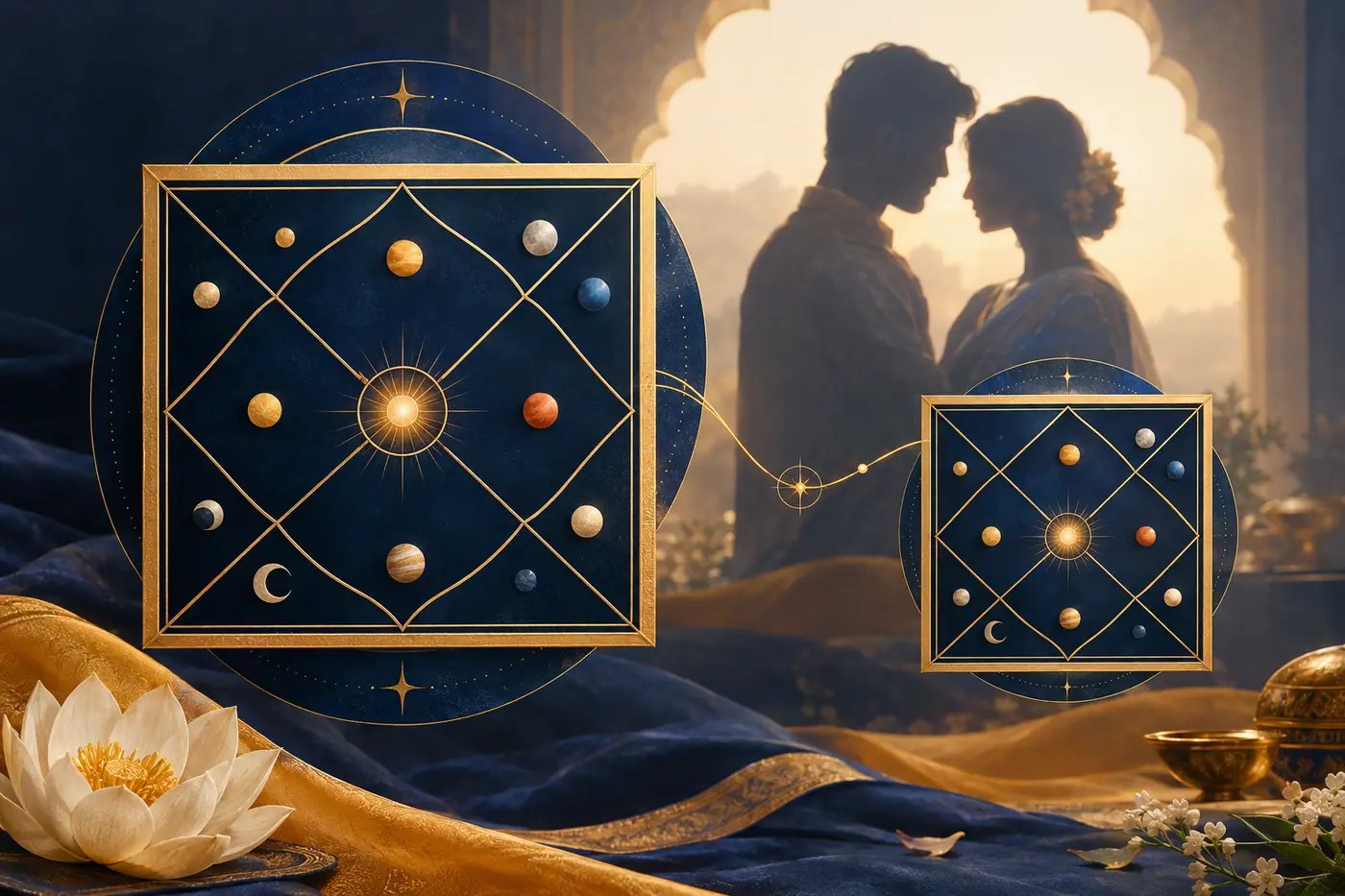
The D9 should be used with the birth chart, not as a replacement for it. A reader who looks only at an isolated Navamsa placement can miss the chart context that gives that placement meaning. Birth time accuracy also matters because divisional charts are sensitive to calculation details. If you are learning to read the rest of a kundli, this step-by-step Vedic birth-chart guide provides useful background.
Can the 7th house predict when you will marry?
Not by itself. Marriage timing traditionally requires additional methods, including planetary periods, transits, and supporting indications from the 7th house, its lord, Venus, Jupiter, and the Navamsa. Even then, astrology offers an interpretive framework rather than a guaranteed date.
Timing should therefore be used thoughtfully. A period may highlight meeting someone, defining a commitment, reassessing a relationship, or learning more about partnership, not only producing a wedding. Real-life choices, circumstances, consent, communication, and compatibility remain essential.
A practical 7th-house marriage checklist
- Confirm the birth data. Use the most accurate birth date, time, and location available. An uncertain time can change the ascendant and house structure.
- Identify the ascendant and 7th-house sign. This establishes the starting point for the marriage analysis.
- Find the 7th-house lord. Note its sign, house, dignity, conjunctions, and aspects.
- List planets in or aspecting the 7th. Interpret them as themes, not fixed outcomes.
- Review Venus, Jupiter, and the Moon. Consider affection, guidance, emotional needs, and their condition in the chart.
- Compare the birth chart with the Navamsa. Look for repeated themes rather than relying on a single placement.
- Only then examine timing. Use planetary periods and transits as supporting evidence, not as an isolated promise.
- Translate symbolism into action. Ask what the chart suggests you can practice: clearer communication, stronger boundaries, patience, or more honest expectations.
Frequently asked questions
Is the 7th house only about marriage?
No. It is also traditionally associated with committed partnerships, business partnerships, contracts, and significant one-to-one relationships.
Does a difficult planet in the 7th house deny marriage?
No single placement proves denial, divorce, or unhappiness. The planet’s dignity, lordship, aspects, conjunctions, Navamsa condition, and timing must be considered with the full chart.
Can the 7th house reveal exactly who I will marry?
It may be interpreted as describing relationship themes or qualities, but it cannot reliably identify a specific person or guarantee an outcome.
Do I need the Navamsa chart?
Traditional marriage analysis commonly examines the Navamsa alongside the birth chart. It should not replace the birth chart, and accurate birth data is important for calculating it.
What you can do today
Start by writing down your confirmed birth details and the questions you actually want a chart reading to address. Then review the 7th house and its lord without jumping to conclusions about a future spouse. If you want help locating these factors, you can explore HoroscopeDoc for a personal Vedic birth-chart reading. For relationship questions involving two people, compare the full charts and communication patterns rather than relying only on Sun signs; our guide to compatibility in Vedic astrology offers a starting point.
The most constructive use of the 7th house is not fortune-telling by one placement. It is self-awareness: noticing how you approach commitment, what you need from partnership, and which relationship skills you can strengthen today.
